Showing posts with label Bird. Show all posts

Lockdown Bird Ringing

Despite lockdown restricting many people's ability to get out into nature and connect with the environment, for me at least it has shifted my focus onto the wildlife found in my local area, and as my previous blog alluded to, you'd be amazed at what you can find if you just take the time to look. 

As a keen birder and bird ringer, not being able to access some of my usual sites has been a bit of a bummer, but I feel very fortunate to have been able to continue ringing in my modest suburban garden, and it's been quite remarkable seeing just how many birds use the feeders on a daily basis. Since the start of Lockdown 2.0 on 5th November 2020, I have caught 170 birds in our 10 x 14 m garden, 123 of which were Goldfinches. Other species included 20 tits (Blue, Great & Coal) and seven Greenfinches.

Adult male Goldfinch Carduelis carduelis

Over the last week or so, a number of Siskins have joined the other finches on the feeders, and whilst scanning them with binoculars I was surprised to see that at least two of them already had rings on (very exciting as I've not ringed any Siskins in my garden before). I wasn't quick enough to read the ring numbers with bins or a scope however, so I made various attempts to catch them. 

In doing so I managed to catch not one, but eight birds, far more than I originally thought were present. This included one of the birds already wearing a ring, and after submitting the data to the British Trust for Ornithology (who coordinate the British Ringing Scheme), I was delighted to receive the news that the bird had originally been ringed in Melvich, Highland on 10th May 2019, some 629 days previously and having moved a total of 824 km... not too shabby for a bird weighing ~13g!

Adult male Siskin Carduelis spinus

This just goes to show how much bird ringing helps to further our knowledge and understanding of British birds, their population changes and movements, as well as highlighting the importance of gardens for birds and other wildlife. You can find out more about ringing and how to get involved on the BTO's website, and for an animated visualisation of Siskin movements in Europe, the Euro Bird Portal is pretty snazzy.

Adult female Siskin Carduelis spinus

Siskin movement from Melvich, Highland to NE Hampshire, a total of 824 km.

Munghorn Gap

Munghorn Gap Bird Banding ~ 23rd & 24th August 2019 ~

Last weekend I was invited to join a bird ringing trip at Munghorn Gap, a nature reserve located about 2.5hrs inland from Newcastle, in the NSW Central Tablelands. Bird ringing (or banding as it is known here) has taken place at Munghorn for over 50 years, meaning that a vast amount of data has been collected on the size, health, site fidelity and longevity of birds within this population. 

For those who don't know, bird banding (ringing) consists of catching wild birds and fitting a uniquely numbered lightweight metal ring to their leg. Bird ringing generates information on the survival, productivity and movements of birds which allows us to understand how and why populations are changing so that the most effective conservation measures can be put in place to protect them. The Australian Bird and Bat Banding Scheme and British Trust for Ornithology websites both provide excellent information regarding the value of bird ringing/banding, including examples of some incredible migration events and longevity records, none of which would be known otherwise.

Anyway, I arrived at the campsite at Honeyeater Flat on Thursday evening, set up my tent and had some dinner before meeting the other banders once they returned from setting up nets for the follow day's session. On Friday (23rd) morning we banded at the Moolarben Picnic Area, a lovely woodland site with a spring situated in a gulley adjacent to the main walking track, which proved to be a real magnet for many species, including Honeyeaters, Thornbills and Fairy-wrens.

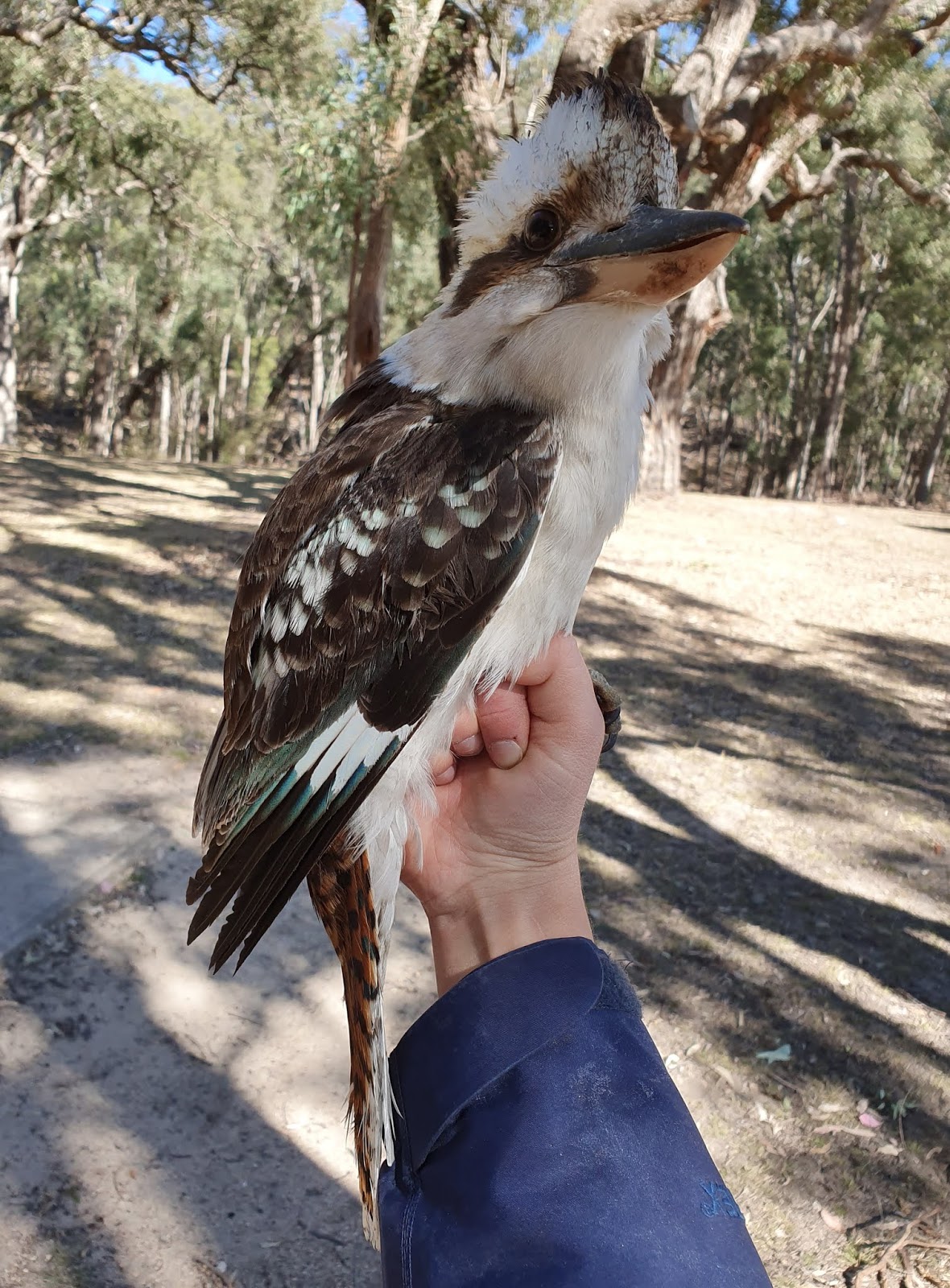
Over the course of the morning we caught a wide variety of species, from small Superb Fairy-wrens Malurus cyaneus and Striated Thornbills Acanthiza lineata, to medium-sized White-naped Honeyeaters Melithreptus lunatus and White-throated Treecreepers Cormobates leucophaea and we even got some larger species: Laughing Kookaburra Dacelo novaeguineae, Noisy Friarbird Philemon corniculatus and Australian King-parrot Alisterus scapularis! We also caught some of my favourite Australian birds so far: Varied Sittella Daphoenositta chrysoptera and Eastern Spinebill Acanthorhynchus tenuirostris, which were both amazing to see up close!

Superb Fairy-wren Malurus cyaneus
Laughing Kookaburra Dacelo novaeguineae
Varied Sittella Daphoenositta chrysoptera
Eastern Spinebill Acanthorhynchus tenuirostris

We banded until about 13:00 before taking down the nets and having some lunch. Once we were refuelled, we headed to our banding site for Saturday morning, which was only down the road from the campsite and set up the nets ready for the following morning. After a bit of down time back at the campsite, we went to a nearby pub for dinner and some warmth.

On Saturday morning we were up at the crack of dawn and soon had the nets open again - there was an initial rush of birds (mostly White-naped Honeyeaters) which steadily declined until we packed up around lunchtime. Over the course of the morning we caught a variety of species, including honeyeaters, treecreepers, finches, fairy-wrens and thornbills. My personal favourites were: White-plumed Honeyeater Ptilotula penicillata and Diamond Firetail Stagonopleura guttata. 

Diamond Firetail Stagonopleura guttata
White-plumed Honeyeater Ptilotula penicillata
Once we had packed up and had some lunch, we headed back to the campsite where I packed up my tent and all my gear into the car. Unfortunately I had an assignment due in that week which meant I couldn't stay for an extra day of banding. Over the course of the two sessions, a number of the birds we caught were re-captures (banded on previous trips), and a fair few were quite old: one of the White-plumed Honeyeaters (weighs ~20g) was banded at the site over 10 years ago and a Striated Thornbill (weighs ~7g) was banded nearly 14 years ago!! This goes to show the importance of banding in furthering our understanding of these birds in terms of how long they live and where they spend their time. 
Double-barred Finch Taeniopygia bichenovii
Yellow-tufted Honeyeater Lichenostomus melanops

My first pelagic!

Sydney Pelagic ~ 17th August 2019 ~

Well, it seems to have been an absolute age since I last updated my blog, for which I apologise - as usual, life got in the way! As some of you already know, I've been in Australia for the last 1.5 months & will be here for a further 10 months as I undertake an exchange year through my undergrad degree. As a (very) brief summary of the last month and a bit: I've attended a conference in Darwin & spent 10 days birding in the Northern Territory (mainly Kakadu & Litchfield NP - blog to come at some point), visited relatives on the Gold Coast, started Uni in Newcastle, gone on a whale-watching trip, bought a car, attended a Natural History Illustration Camp, experienced the Newy nightlife & visited some of Australia's stunning beaches.

Left: Burleigh Heads beach, QLD & Right: Rock pool at Merewether Rock Platform, NSW

That nicely brings us to this past weekend, when I drove down to Sydney on Friday evening (10/10 would not recommend!) before staying at the Bondi Beachouse YHA. Unfortunately I arrived after it got dark and so I didn't really fancy walking to the beach. Luckily there was a Thai restaurant nearby so that satiated my hunger & I got an early night. On Saturday morning I woke up before my 6am alarm, full of excitement for what lay ahead. I remembered to take my travel sickness tablet at 6.30am and then checked out of the YHA and drove to Rose Bay Wharf where the boat picked us up at 7am.

Great views of Sydney Opera House and Sydney Harbour Bridge as we headed out to sea

For the next 3 hours we made our way out to sea, and it didn't take long for the birds to be attracted to the smell of chum. As we made our way out of Sydney Harbour, Silver Gulls Larus novaehollandiae and Great Crested Terns Thalasseus bergii loitered around the boat, hopeful of some fishy matter being tossed their way. Before too long, the first 'proper' seabirds put in an appearance. First up was a Wedge-tailed Shearwater Ardenna pacifica, swiftly followed by a Black-browed Albatross Thalassarche melanophris and Brown Skua Catharacta antarctica.

Wedge-tailed Shearwater Ardenna pacifica
Black-browed Albatross Thalassarche melanophris
Brown Skua Stercorarius antarcticus

As we got further out, the gulls and terns stopped pursuing us, but the albatrosses and skuas continued to follow and increase in number. A bit further out, a White-capped (Shy) Albatross Thalassarche steadi joined the throng of birds following the boat's wake in a fierce battle to get the fish scraps being thrown out. We also bumped into a few Humpback Whales Megaptera novaeangliae which put on a fantastic display for us and stayed pretty close to the boat for about 15 minutes!
White-capped (Shy) Albatross Thalassarche steadi
Humpback Whale Megaptera novaeangliae

Once we got out to sea, the boat stopped and put out the slick. Over the time that we were stopped, we were treated to views of Fairy Prion Pachyptila turtur, White-faced Storm-petrel Pelagodroma marina and Providence Petrel Pterodroma solandri in addition to the constant presence of Brown Skuas and four species of Albatross (Black-browed, White-capped, Indian Yellow-nosed Thalassarche chlororhynchos and Campbell's Thalassarche impavida).
Fairy Prion Pachyptila turtur
Providence Petrel Pterodroma solandri
Brown Skua Stercorarius antarcticus
Black-browed Albatross Thalassarche melanophris
Black-browed Albatross Thalasarche melanophris
Indian Yellow-nosed Albatross Thalassarche chlororhynchos
Campbell's Albatross Thalassarche impavida
On our way back, we came across a large feeding flock of Wedge-tailed and Hutton's/Fluttering Shearwaters, though they were pretty distant and by this point I was feeling a little worse for wear so I didn't manage any photos. In all, we spent around 9 hours at sea, saw 14 species and I realised that albatrosses are even bigger than I imagined them to be!! It's safe to say that the experience left me buzzing for days afterwards and I can't wait for my next pelagic!
Wedge-tailed Shearwater Ardenna pacifica

Dunlin

Head to any coastal mudflats in the winter, and you are likely to see a whole host of wading birds, including Dunlin (Calidris alpina), Turnstone (Arenaria interpres), Sanderling (Calidris alba) and Knot (Calidris canutus). Dunlins are the most common of these winter waders and often feed in flocks, so where there's one, there's usually a whole lot more somewhere nearby!

Dunlins are small wading birds that have a slightly decurved black bill, black legs and a short primary projection. Their wingspans range between 33-40cm and they weigh around 49g. As with most waders, Dunlins moult between their two plumages, a brighter, more colourful one for the breeding season, when they need to look their best, and a fairly dull, grey-brown one for the winter, when looks aren't so important. Using a combination of sight and touch, they feed on a variety of invertebrates, including insects, molluscs and oligochaete worms.

© https://adventuresinmothland.wordpress.com/2013/05/28/evil-scud/
Dunlin (Calidris alpina) in breeding plumage.

There are currently 10 subspecies of Dunlin that are officially recognised, however the taxonomy surrounding this species is very complex and often changing. Of the 10 official subspecies, 3 have been recorded in Britain: schinzii, alpina and arctica. The schinzii subspecies of Dunlin breed in the UK, with around 9,600 breeding pairs and winter in west Africa, while the arctica subspecies are birds that breed in Greenland and pass through the UK in autumn in small numbers. The C. a. alpina subspecies breeds across Siberia, all the way to northern Scandinavia and account for pretty much all of the Dunlins that winter in the UK.

At the end of February, the UK was struck by the 'Beast from the East', or as most of Northern Europe calls it, winter. This resulted in about a week of sub-zero temperatures and heavy snow here in East Anglia. The freezing conditions and snow cover caused many problems for wildlife, with many reports of dead birds across the country and East Anglian region. Waders were particularly vulnerable as they rely on being able to probe muddy areas to find food, however since the conditions caused widespread freezing, they weren't able to access their usual food resources for a prolonged period of time, leading to starvation.

Bowthorpe Marsh looking like a frozen wasteland

During the cold spell, some of my Ecology course mates and I tried to venture out as often as we could to do some proper winter birding. On 3rd March all our lectures were cancelled, so we made the most of it and spent all day out birding around Earlham, Colney, Bowthorpe and Threescore. During our travels we came across a pair of Lapwings, including this unfortunate individual, which had a large ball of ice stuck to its tail, preventing it from flying. We dutifully broke up the ice ball and then warmed it up for a few minutes, before releasing it to join its mate on the river. It was very bizarre to see, but I suppose it may have roosted on the edge of an unfrozen puddle, which froze overnight or something... I guess we'll never know.

Lapwing (Vanellus vanellus) with a large ball of ice attached to its tail.
Anyway, back to the topic of this post, the Dunlin. A few days prior to the Lapwing encounter, a few of us had headed out birding along the River Yare when we spotted a Dunlin at the water's edge. Dunlins are a decent bird for the UEA recording area, especially when they're on the ground like this one. It was nice to see, even if it did look a bit sorry for itself in the freezing conditions. Before we carried on our walk, someone made a joke about the Magpies that were loitering around... so to skip to the end, as we returned from our wanderings later that day, we decided to head back along the Yare to see if the Dunlin was still moping about. It was.

Dunlin (Calidris alpina) looking a bit sorry for itself, shortly
before it got taken by a Magpie.
However, a few seconds after we arrived, a Kestrel appeared out of nowhere and swooped down at the Dunlin, but didn't try to catch it. Unfortunately, a Magpie must have clocked what happened and made a beeline straight for the Dunlin, picking it up with very little struggle and carrying it off into the woods, where the commotion of many other Magpies could be heard. A sad end to a nice day's birding, although perhaps a fairly swift death from a Magpie's bill was a kinder end than potential starvation for the Dunlin...

A few days later, once the snow had melted and the ground had (mostly) thawed, another Dunlin rocked up on Earlham Marsh, where we enjoyed nice views of this more perky looking bird and the other UEA birders managed to see it as well.

Dunlin (Calidris alpina) looking a lot less moribund!

Further reading that may be of interest:

Monfragüe National Park, Extremadura: PART 2

Monfragüe National Park PART 2 ~ 17-19th October 2016 ~ 

Carrying on from PART 1...

Day 4 (18th): After breakfast we made our way to Serradilla. From there we took 'La Ruta de la Garganta del Fraile', aka Friar's Gorge Route. It was a stunning walk, with some amazing scenery and great birding along the way with highlights of Serin, Hoopoe, Iberian Magpie and Rock Sparrow! After a coffee stop in Serradilla, we headed to Mirabel Castle for lunch and some birding. The best of the bunch here was Black Vulture, Woodlark and Cirl Bunting. After lunch we went to a cork oak forest to see "Padre Santo", one of the oldest Cork Oaks in the region. In this area we also saw Nuthatch, Great-spotted Woodpecker and Short-toed Treecreeper. Before heading back to our accommodation in Plasencia, we met with the Mayor of Mirabel to talk about ecotourism in the local area, as well as how undiscovered the National Park and Biosphere Reserve are, despite their fantastic array of wildlife.
Cirl Bunting (Emberiza cirlus)
"Padre Santo" 

Day 5 (19th): Some members of the group left mid-morning, leaving the rest of us to explore Trujillo, our final destination of the trip. The municipality of Trujillo is full of history, with many medieval and renaissance buildings. We explored the old town for a few hours, learning a lot about the local history. In Plaza Mayor the Red-rumped Swallows and Crag Martins kept me suitably occupied, while we also saw Merlin, Hawfinch, Serin and Black Redstarts on our wanderings around the town. At about 12.30 I began the 3 hour journey back to the airport where I then flew back to the UK. The drive to the airport was not without birds, of course, with more Griffon Vultures, Spotless Starlings, an Iberian Grey Shrike or two and our one and only White Stork of the trip.
Cospsoptera jourdanaria
Trujillo
View from Trujillo Castle
All in all, it was a thoroughly enjoyable few days spent exploring an incredibly biodiverse environment with excellent company and seeing a plethora of new species (26 birds and lots else besides). A huge thank you once again to David Lindo and the Diputación de Cáceres for making the trip possible and for the invite!

I would highly recommend a visit for the birds, the history and the culture and I hope it's not too long before I return to Extremadura to explore it some more...

Monfragüe National Park, Extremadura: PART 1

Monfragüe National Park PART 1 ~ 15-17th October 2016 ~ 

Back in October I was lucky enough to spend 5 days in the Monfragüe National Park in Extremadura. I had never been to Spain before, nor had I really birded Europe outside of the UK, so there were plenty of new experiences to be had!

Before I go any further I must say a massive thanks to David Lindo (@urbanbirder) for inviting me on the press trip, the good folks at Diputación de Cáceres (@Turismo_DipCC) for making the trip possible, Martin Kelsey (@casaelrecuerdo) for all his local knowledge and to the other trip participants, Sorrel Lyall, Emma-louise Cole, Niki Bloom and Miriam Darlington, for their great company! It really was a brilliant trip and I hope it won't be too long before I get to return to Extremadura to explore it some more...

Day 1 (15th): I arrived at Madrid Airport where I met David, Martin and Niki and had a beer or two to chill out while we waited for the others to arrive. A little while later Sorrel, Emma and Miriam arrived and we soon began the 3 hour drive to our accommodation. On the drive we saw 19 species, including a rather incredible juvenile Spanish Imperial Eagle (the first of so many lifers)! On arrival at the accommodation it wasn't long before bins were donned and scopes unpacked. We were soon treated to brilliant scope views of hundreds of Griffon Vultures swirling around on the thermals and some Crag Martins whizzed over. A short walk with Sorrel produced Hoopoe, Zitting Cisticola, Grey Wagtail, Great White Egret, Crested Lark and a large roost of House Sparrows. The day ended with our first taste of traditional Spanish cuisine.
Beautiful Gothic (Leucochlaena oditis)

Day 2 (16th): After a traditional Spanish breakfast of meats, cheese and pastries we made our way to Castillo de Monfragüe. On the way we stopped to look at some geology where you could see ripples in a rock which used to form the seabed near Australia - pretty neat indeed! At Castillo de Monfragüe we saw lots more Vultures, both Griffon and Black, a Red-billed Chough, some Crag Martins and a stunning Hawfinch! The views were spectacular out over the River Tagus and the surrounding dehesa.

View from Monfragüe Castle overlooking the River Tagus
View from Monfragüe Castle overlooking dehesa
We then headed to Peña Falcón (aka Falcon Rock) where we were greeted with more vultures, some stunning Black Redstarts, Rock Bunting and the amazing Blue Rock Thrush! Blue Rock Thrush is a bird I have long admired in my Collins guide so to actually see one was awesome and it totally exceeded my expectations! For lunch, we headed to Villareal de San Carlos and added Red-rumped Swallow to our list. We also saw numerous butterflies and a Large Psammodromus Lizard which posed for photos. The afternoon was spent at Portilla del Tietar where we got insane views of a Spanish Imperial Eagle coming down to drink and rounded the day off with the eerie sounds of Eagle Owl!
Blue Rock Thrush (Monticola solitarius)
Large Psammodromus Lizard (Psammodromus algirus)
Griffon Vultures (Gyps fulvus)
Griffon Vulture (Gyps fulvus)
Spanish Imperial Eagle (Aquila adalberti)
Day 3 (17th): After another delicious breakfast we headed to Arrocampo Reservoir, an impressive wetland site with a number of elevated bird hides for improved viewing. We spent most of the morning at the reservoir and saw an impressive array of species. The highlights for me were Squacco Heron, Bluethroat, Sardinian Warbler and hearing Penduline Tits. A local coffee shop in Almaraz beckoned, after which we headed to the Orchydarium for a special tour and introduction to the great work they do on Orchids. After the tour, we headed back to Arrocampo to explore a different part of the reserve. The species list was much the same as the morning except for an Iberian Grey Shrike, a small flock of Corn Buntings and a Dartford Warbler. To finish the day we headed to Toril, where we visited an information centre and learnt a lot more about the local area, its history and the environment.
View from the hide at Arrocampo
Cattle Egret (Bubulcus ibis)
My Swarovski ATS 65HD and 25-50W eyepiece are an epic combo for birding!
Moorhen and Purple Swamphen
Inside the Orchydarium
Iberian Grey Shrike (Lanius meridionalis
The information centre in Toril


I have written about the rest of the trip in PART 2.